
RDC Katamba Applauds Private Schools as Bishop Asili Wins Junior East African Debate
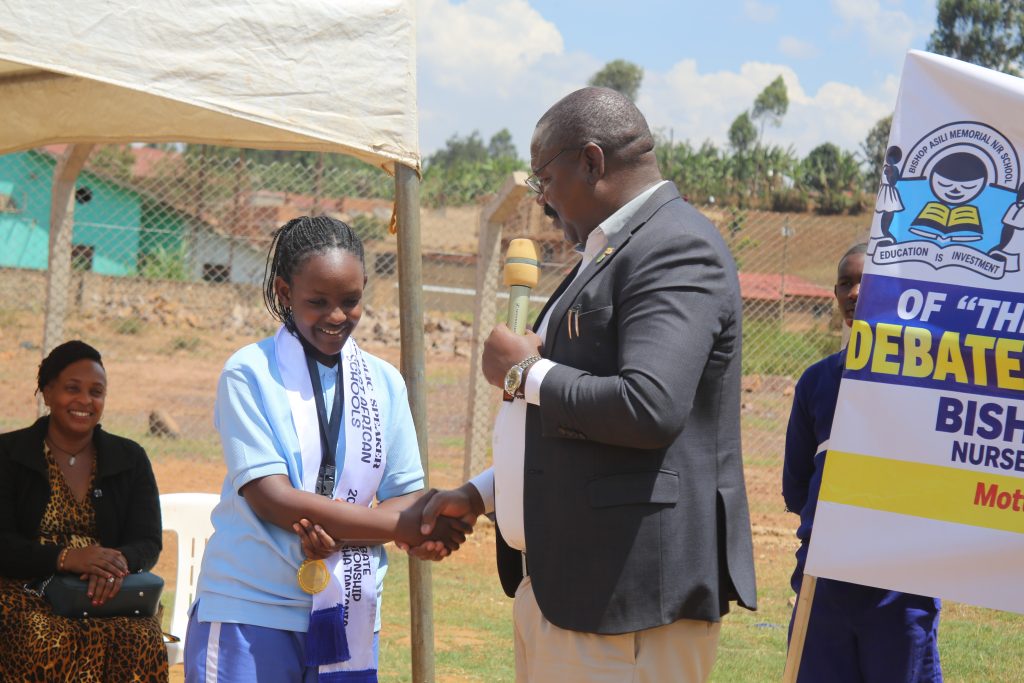
KABALE — Kabale Resident District Commissioner (RDC) Major Godfrey Katamba has applauded private schools for supporting government efforts in the education sector through the Public-Private Partnership.
Katamba made the remarks on Tuesday at Bishop Asili Memorial Nursery and Primary School in Southern Division, Kabale Municipality, where the school community and residents gathered to celebrate the pupils’ success in the East African debate competition.
The competition was held over the weekend at the East African Legislative Assembly (EALA) in Arusha, Tanzania, where four pupils from Bishop Asili Memorial School emerged winners in the Junior Debate category.
The pupils were welcomed back to Kabale town with a band, cheers from members of the public and representatives from different schools who gathered to celebrate their achievement.
Katamba said the success demonstrates the important role private schools play in complementing government efforts in providing quality education.
“Private schools have continued to support government in the Public-Private Partnership, and we appreciate the role they are playing in educating our children,” Katamba said.
He congratulated Bishop Asili Memorial School for exposing learners to debate and other co-curricular activities, saying such programmes help children develop confidence and leadership skills.
Kabale Municipality Inspector of Schools Agness Asiimwe said private schools have been instrumental in promoting good performance in both academic and co-curricular activities in the municipality.
“Private schools have been very pivotal in the great performance we are seeing in Kabale Municipality and Kabale at large,” Asiimwe said.
She said the debate competition was an important platform for identifying and nurturing young talent.
“These debate competitions bring out the talents of our young stars and prepare them to become great leaders and legislators in the near future,” Asiimwe said.
Asiimwe added that government would continue supporting skills development and co-curricular activities in schools.
“Government will continue to support skills and co-curricular activities because education is not only about what learners get in the classroom,” she said.
The Headteacher of Bishop Asili Memorial School, Sr. Margaret Tusiime, attributed the school’s success to unity, teamwork and commitment among the teaching staff and learners.
Tusiime said the school, which was established in 2000, has grown into one of the leading primary schools in the country.
“With unity and teamwork, the school that started in 2000 is now among the top primary schools in the country in terms of good performance,” Tusiime said.
She encouraged other schools to embrace hard work and ensure that learners are brought up with strong values.
“We appeal to other schools to live a life of hard work and love the schools, and to bring up children with good values,” she said.
Tusiime also acknowledged government support in improving schools, saying teachers and support staff have a responsibility to raise the standard of education.
“Government support has made our schools better, and it is now upon us as support staff to change Uganda’s education system and take it to international standards,” Tusiime said.
Meanwhile, Eric Batura, Founding CEO of Teachers Debate Network Uganda, one of the organizers of the championship and Headteacher of Nyakayojo Secondary School in Mbarara City South, said the competition attracted 90 teams from Uganda, Kenya and Tanzania, representing 33 secondary schools.
Batura said the championship was organized by Teachers Debate Network Uganda, led by him, together with the Tanzania National Debate Society, led by Christopher Michoro, and the Kenya Oralation Hub.
“The competition attracted 90 teams across Uganda, Kenya and Tanzania. The teams came from 33 secondary schools,” Batura said.
He said Uganda was represented by 16 secondary schools that participated under the umbrella of Teachers Debate Network Uganda.
Batura described the network as a platform for Ugandan debate patrons who organize competitions with an emphasis on transparency, professional judging and learner development.
“This is a network of Ugandan debate patrons that organize debates that are transparent in judgement and professional since they are teachers. They put the needs of the learners at the centre,” he said.
He said the network focuses on holistic development through activities including public speaking, poetry, debate, quiz competitions, storytelling and news anchoring.
According to Batura, Mubende Light Secondary School emerged overall winners, with St. Mary’s College Lugazi as first runners-up and Ntare School as second runners-up.
Nyakayojo Secondary School was recognized as the most upcoming school, while Mbarara Army Boarding Secondary School was named best in public speaking.
Bishop Asili Memorial School emerged best in the Junior Debate category, while Bamusiima Memorial School was recognized as the most upcoming school in the junior category.
Batura said the East African competition is a stepping stone to the next stage of the debate programme.
“After the East African Debate Championship, the next stage will be the African Debate Championship, which is scheduled to take place at the University of Pretoria in South Africa in February next year,” Batura said.
Bishop Asili Memorial Nursery and Primary School has also built a strong reputation in academic performance. According to the school, it was the best-performing primary school in Uganda in the 2017 Primary Leaving Examinations (PLE) and is regarded as one of the best-performing schools in Western Uganda and among the leading primary schools in the country.
The latest achievement in the East African Junior Debate Championship adds to the school’s record of academic and co-curricular success, as it continues to emphasize both strong academic performance and the development of learners’ talents and leadership skills.
ENDS/////////




