
Gen. Moses Ali: The Lion of Adjumani Who Shaped Uganda’s Political and Military History
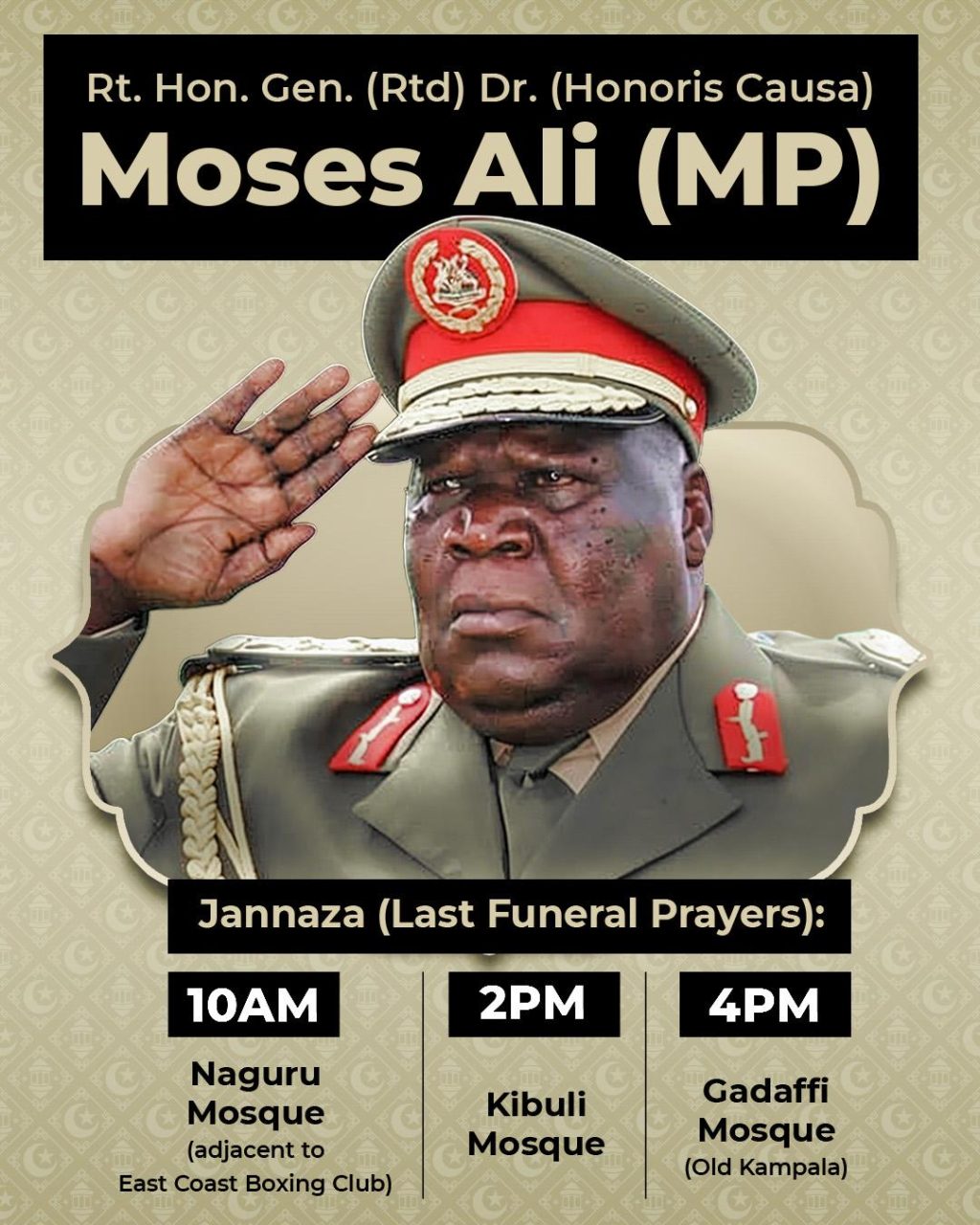
From the battlefields of Uganda’s turbulent post-independence years to the corridors of power, Gen. Moses Ali lived a life that mirrored the country’s modern history. Soldier, rebel leader, Cabinet minister, legislator and farmer, the veteran politician remained one of Uganda’s most enduring public figures for more than five decades.
Born on April 5, 1939, in Meliaderi Village, Atabo Parish, Pakele Division in present-day Adjumani District, Moses Ali was the son of Muhammad Ali and Veronica Porsche Ali. He began his education at Erepi Church of Uganda Primary School before completing his O-Level education at Old Kampala Secondary School.
His passion for military service saw him undergo officer cadet, paratrooper instructor and company commander training in Israel before earning a degree in Military Science from the Staff College, Camberley, in the United Kingdom in 1972. Despite his distinguished military career, Ali also pursued legal studies, obtaining a Bachelor of Laws degree from Makerere University, a Diploma in Legal Practice from the Law Development Centre, and later further qualifications in law and intelligence studies.
Gen. Ali joined the Uganda Army as a cadet officer in 1968 and was commissioned as a Second Lieutenant the following year. He rose rapidly through the ranks, becoming commander of the Uganda Paratrooper School, a Colonel in 1972 and Brigadier in 1974. In later years under the Uganda People’s Defence Forces (UPDF), he was promoted to Lieutenant General in 2003 before becoming Uganda’s first four-star General in 2012.
His political career spanned several governments. During President Idi Amin’s administration, Ali served as Minister of Provincial Administration and later Minister of Finance, playing a key role during one of the country’s most controversial periods.
Following Amin’s overthrow in 1979, Ali fled to Sudan and later led the Uganda National Rescue Front (UNRF) rebellion in West Nile during the early 1980s. The conflict ended on November 16, 1986, when he signed a peace agreement with President Yoweri Museveni in Arua, paving the way for the integration of UNRF fighters into the national army and marking the beginning of a new chapter in his public life.
Ali returned to mainstream politics under the National Resistance Movement (NRM), serving as a Member of Parliament and Cabinet minister from 1996. Over the years, he held several ministerial portfolios, including Tourism, Trade and Industry, Internal Affairs, Finance, Disaster Preparedness, and Youth, Culture and Sports.
Although he lost his parliamentary seat in 2006, he returned to Parliament in 2011 and continued representing the people of Adjumani. Between 2016 and 2026, he served in the country’s top leadership as Deputy Prime Minister, including as Second Deputy Prime Minister in his final years in Cabinet.
Outside politics, Gen. Ali was widely respected as a successful commercial farmer and was often cited by President Museveni as a model for modern agriculture in the West Nile sub-region. He championed government wealth-creation programmes, including the Parish Development Model, Emyooga, Youth Livelihood Programme and Operation Wealth Creation.
Despite advancing age and health challenges, including treatment abroad and a speech impairment in recent years, Gen. Ali remained active in public life. In 2025, at the age of 86, he picked nomination forms to seek another parliamentary term, describing it as his final election.
His omission from the Cabinet list in 2026 marked the end of one of the longest ministerial careers in Uganda’s history.
To many in West Nile, Gen. Moses Ali was more than a politician. He was a symbol of resilience, influence and transformation—a leader who reinvented himself through changing political seasons while maintaining a prominent place in Uganda’s national affairs.
His passing closes a remarkable chapter in Uganda’s political and military history, leaving behind a legacy that will be remembered for generations.
Gen. Moses Ali is survived by his family and countless Ugandans whose lives were touched by his decades of public service.
ENDS




